Gabriel G Tabarani
For decades, American influence rested on a simple bargain: the more America’s allies depended on Washington for their security, the greater Washington’s influence over their strategic choices.
The Trump administration wants to rewrite that bargain. It has repeatedly urged allies to assume greater responsibility for their own defense while reducing America’s military commitments abroad. Yet it also expects those same allies to continue aligning with U.S. political and strategic priorities as though nothing fundamental has changed.
That tension raises a larger question: can a great power reduce its commitments while preserving the same degree of political influence?
Since returning to the White House, President Donald Trump has consistently argued that America’s allies have relied too heavily on U.S. protection. He has criticized NATO members for underspending on defense, questioned longstanding security guarantees, threatened troop withdrawals from Europe and Asia, and insisted that wealthy partners should bear a larger share of the burden. Under the banner of “America First,” the message has been clear: America should do less so that others do more.
That is a legitimate strategic debate. After decades of underwriting much of the international security order, the United States is entitled to ask whether its global commitments have become too costly or too open-ended.
The contradiction lies elsewhere.
Washington wants its allies to become more militarily independent without becoming more politically independent.
Security dependence does not merely create a need for protection; it also creates influence for the power providing that protection. As dependence declines, so does that influence—even if military superiority remains unchanged. The more capable countries become of defending themselves, the more freedom they inevitably acquire to make decisions that diverge from the preferences of even their closest allies.
This is no longer a theoretical proposition.
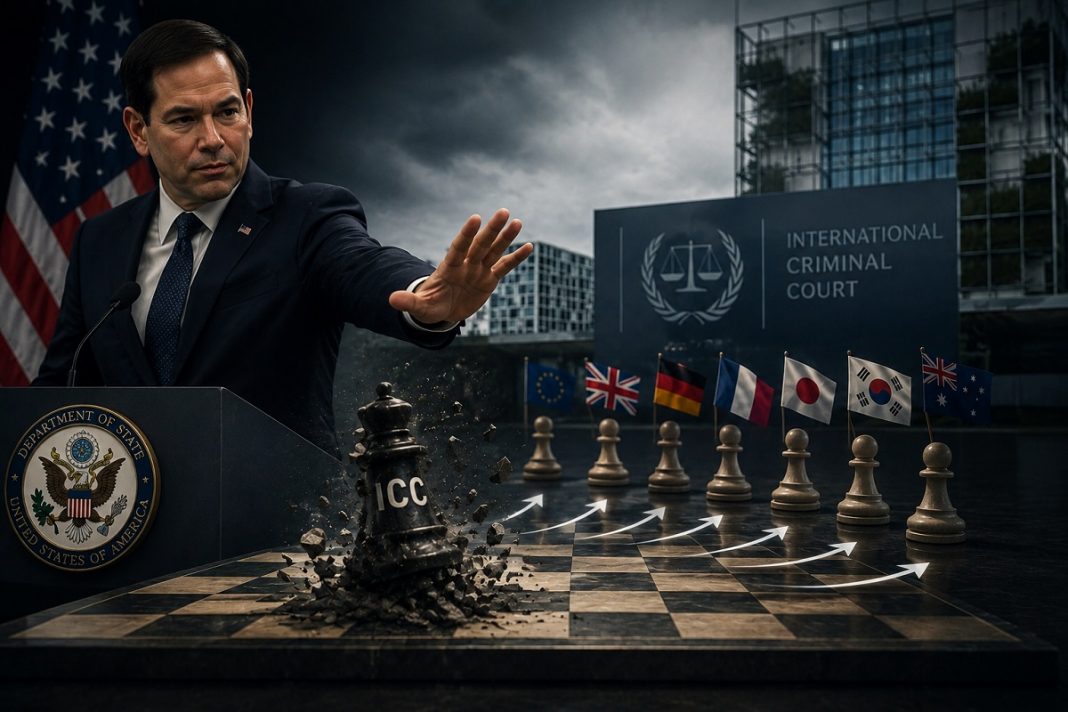
The Trump administration’s campaign against the International Criminal Court illustrates the point with unusual clarity. Secretary of State Marco Rubio has declared that the United States would work to dismantle the Court “brick by brick,” while administration officials have suggested that countries benefiting from American assistance should reject what Washington describes as the ICC’s “false authority.”
The implication is difficult to miss. Washington encourages allies to become strategically self-reliant, yet appears far less comfortable with political or legal autonomy when it conflicts with American preferences.
Herein lies the real paradox.
American influence after World War II rested on far more than military superiority. It was sustained by an extensive network of alliances, institutions and shared rules. NATO, the Bretton Woods system, the United Nations, the World Bank, and later American support for elements of the international legal order all reflected the same principle: U.S. leadership proved most durable when exercised within broadly accepted institutional frameworks.
Critics often argued that this order disproportionately favored Washington, and they were not entirely wrong. Yet many allies accepted American leadership because it offered predictability, consultation and mutual benefit.
Influence was not merely imposed; it was cultivated.
Today, however, the Trump administration appears to envision a different equation: fewer commitments in exchange for the same—or even greater—influence.
History offers few examples of such an arrangement succeeding.
As countries reduce their dependence on a great power, they naturally gain greater freedom to disagree with it.
Europe illustrates the point clearly. Russia’s invasion of Ukraine has driven defense spending across the continent to levels unimaginable only a few years ago. Germany has embarked on the most significant military rearmament in its postwar history, while “strategic autonomy” has become a permanent feature of European political debate.
Ironically, these are precisely the developments Washington has long encouraged.
Yet greater military capability inevitably produces greater political autonomy. A Europe better able to defend itself is also a Europe more willing to pursue policies that do not always align with American preferences—whether on China, climate policy, digital regulation or international legal institutions.
Nor is Europe unique.
Japan, South Korea, Australia and several Middle Eastern partners are likewise expanding their defense capabilities and reducing their reliance on American security guarantees. As they do, domestic political priorities inevitably carry greater weight than external expectations.
This is not evidence of failing alliances. It is the natural consequence of successful ones.
Strong allies are not dependents. They are partners capable of both agreement and disagreement.
The larger question, therefore, is whether Washington still recognizes the foundations of its own influence.
In the twenty-first century, power rests less on coercion than on credibility. Influence increasingly depends on trust, predictability and respect for the autonomy of partners.
When allies come to view American policy as transactional or contingent upon political conformity, they naturally hedge their bets. They diversify security partnerships, strengthen regional institutions and pursue greater strategic independence.
Ironically, these are precisely the outcomes Washington says it wants.
The difference is that genuine independence cannot be granted selectively.
Independence is not divisible. Countries do not become independent only where Washington approves. They become free to make choices of their own. If the United States truly wants stronger allies, it must also accept the consequence that comes with strength: greater independence. Sovereign partners will sometimes say no. That is not a failure of American leadership. It is the inevitable consequence of successful alliances.
This article was originally published in Arabic on the Asswak Al-Arab website