Gabriel G. Tabarani
The most devastating economic losses of war are not always those that can be measured in dollars. Buildings can be reconstructed, roads repaired and factories equipped with new machinery. But lost years of education, the erosion of professional skills, the collapse of institutions and the disappearance of confidence in the future are far harder to reverse.
War destroys what societies have built. At its most destructive, it also takes away what they might have become.
That is the deeper warning contained in a United Nations report on the economic and social repercussions of the Israeli occupation, prepared by the UN Economic and Social Commission for Western Asia (ESCWA) and presented to the General Assembly on October 16.
The report documents the devastation of Gaza and the deteriorating conditions in the occupied West Bank, including East Jerusalem. But beyond the scale of the immediate destruction lies a more consequential economic reality: Palestinians are losing not only their productive assets but also the conditions necessary to rebuild a viable economy.
The figures are staggering. Gaza’s gross domestic product contracted by 84 per cent in 2025 compared with 2023. Recovery and reconstruction needs are estimated at $71.4 billion over the next decade. Perhaps most strikingly, the conflict has set human development in Gaza back by an estimated 77 years.
These are not the usual indicators of a severe recession. They describe something closer to the dismantling of an economy.
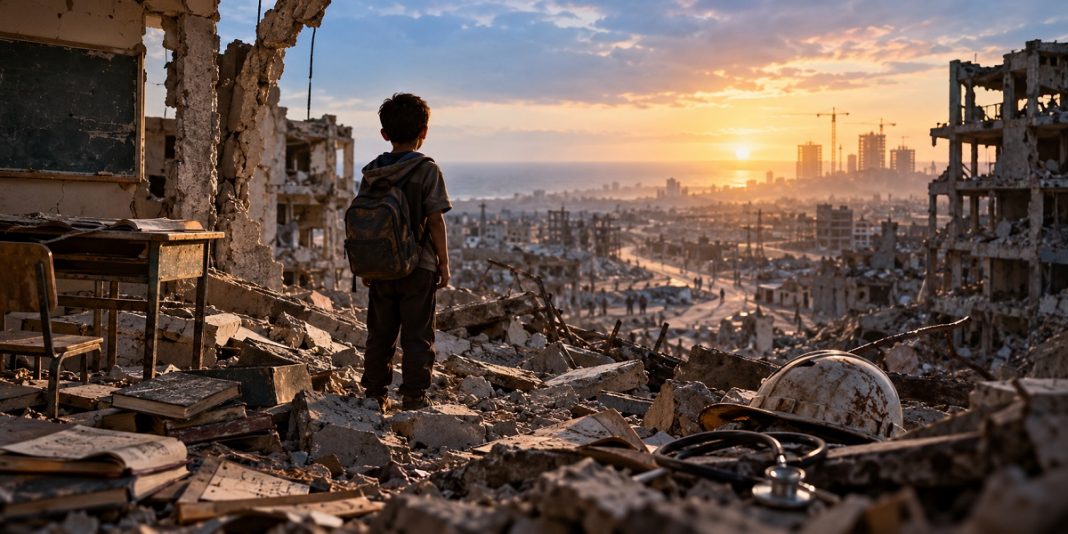
A recession, however deep, generally leaves behind productive capacity that can be reactivated when conditions improve. Businesses may reopen, workers return and investment resume. Gaza faces a fundamentally different challenge. Its factories, homes, schools, hospitals and infrastructure have suffered extensive destruction, while the human capital on which any recovery depends has been severely depleted.
The social indicators are equally alarming. Unemployment across the occupied Palestinian territory reached 46 per cent in 2025, rising to 78 per cent in Gaza. About 700,000 school-age children in the territory remain outside formal education. As of January 2026, only 18 of Gaza’s 36 hospitals were partially functioning.
The implications extend well beyond the present humanitarian emergency. A generation deprived of education, adequate healthcare and opportunities to work will carry the economic consequences for decades. Lost schooling translates into weaker skills and lower future earnings. Prolonged unemployment erodes experience and discourages investment. The deterioration of public health undermines productivity long after the immediate crisis has passed.
The destruction of Gaza, in other words, is not merely a loss of physical capital. It is a profound erosion of the foundations of future growth.
This distinction matters because much of the international discussion has focused on the cost of reconstruction. How much money will be needed? Who will provide it? How quickly can homes, roads and public services be rebuilt?
These are urgent questions. But they are not sufficient.
Reconstruction and economic recovery are not the same thing.
Money can rebuild a factory, but it cannot ensure that the factory will operate if raw materials cannot enter and finished goods cannot reach markets. It can finance a school, but it cannot automatically restore the years of learning children have lost. It can rebuild homes and hospitals, but it cannot establish a functioning economy if people remain unable to move freely, find work or conduct business.
An economy is more than a collection of buildings and machines. It is a system of relationships, institutions, incentives and expectations.
Investors need reasonable assurance that their assets will survive. Workers need access to employment. Farmers need access to their land. Businesses need predictable supply chains, functioning markets and rules that allow them to plan beyond the next emergency.
Without these conditions, even substantial financial assistance risks producing reconstruction without development.
Gaza represents the most extreme manifestation of this crisis. The West Bank illustrates how economic potential can be steadily eroded even where destruction is less comprehensive.
Israeli settlement expansion, land confiscation, demolitions, restrictions on movement and violence by settlers have imposed mounting costs on Palestinian communities and businesses. The UN report documents 2,018 incidents of settler violence resulting in casualties or property damage during the period under review, alongside plans for substantial additional settlement construction in East Jerusalem and Area C of the West Bank.
The economic consequences go far beyond the immediate value of damaged property or disrupted production.
Every restriction that delays workers or goods increases the cost of doing business. Every agricultural area that becomes inaccessible diminishes productive capacity. Every project abandoned because of uncertainty represents investment that will never generate jobs, incomes or tax revenues.
There is also an invisible cost: the companies never established, the careers never begun and the innovations never pursued.
Conventional economic statistics struggle to capture such losses. Yet over time, they may prove as damaging as the destruction that is easier to quantify.
This exposes a central contradiction in the international approach to Palestinian economic development.
Palestinians are routinely encouraged to strengthen their institutions, improve governance, expand the private sector, attract investment and reduce dependence on foreign assistance. These are sensible objectives. Indeed, they are essential to the development of any sustainable economy.
But they presume the existence of conditions that Palestinian businesses and institutions do not fully control.
An economy cannot be expected to achieve financial independence while its revenues remain vulnerable to external restrictions. A competitive private sector cannot flourish when the movement of people, goods and capital is severely constrained. Institutional reform, however necessary, cannot compensate for the absence of reliable access to land, resources and markets.
This does not make reform irrelevant. It makes reform insufficient.
The distinction should inform the next phase of international engagement.
For decades, the response to successive Palestinian crises has relied heavily on humanitarian assistance, emergency financing and reconstruction programmes. Such support is indispensable. Without it, suffering would be immeasurably worse.
But aid can alleviate economic deprivation without removing the conditions that perpetuate it.
When productive activity remains constrained, assistance risks becoming a permanent substitute for the economic opportunities that people need. Instead of helping an economy move towards self-sufficiency, it can become part of a system that manages prolonged dependency.
The problem is not the provision of aid. It is the assumption that more aid, by itself, can resolve a crisis whose causes extend far beyond a shortage of money.
Every dollar spent rebuilding infrastructure that may again be destroyed or rendered unusable raises questions about the sustainability of that investment. Every development programme that ignores restrictions on economic activity risks becoming an exercise in distributing funds rather than creating lasting productive capacity.
This is also a test of the credibility of the international development agenda.
Governments and multilateral institutions routinely emphasise poverty reduction, job creation, human capital and sustainable growth. Yet those objectives become unattainable when the basic conditions for economic life are systematically undermined.
Development is not simply a matter of expenditure. It is a process of accumulation: of capital, knowledge, skills, institutions and trust. Its success depends on the ability of societies to build on previous achievements rather than repeatedly start again from the ruins.
That is why the ultimate measure of Gaza’s reconstruction cannot be the number of housing units completed or the volume of donor pledges announced.
It must be whether Palestinians can rebuild businesses, create sustainable employment, restore trade, educate their children and progressively reduce their dependence on external assistance.
None of this can be separated from the political and legal conditions in which the Palestinian economy operates.
An economy exposed to the continuing threat of losing its assets, markets and resources cannot become viable merely because more money is invested in it. Without a credible framework that protects Palestinian rights and provides lasting stability, reconstruction risks addressing the consequences of destruction while leaving its underlying causes intact.
This places a particular responsibility on Arab governments and the wider international community.
Financing Gaza’s recovery is an urgent obligation. But the more consequential task is to help establish the conditions under which Palestinians can sustain that recovery themselves.
That means treating freedom of movement, access to resources, commercial activity, investment security and economic rights not as secondary considerations to be addressed after reconstruction, but as essential foundations of reconstruction itself.
It also means recognising that an economy cannot be rebuilt indefinitely under conditions that prevent it from becoming self-sustaining.
The estimated cost of rebuilding Gaza can now be expressed in tens of billions of dollars. The cost of denying Palestinians a viable economic future cannot be captured in any balance sheet.
And that is why the most important question facing the next international donors’ conference is not simply how much money will be required to rebuild Gaza.
It is what must change to ensure that Gaza does not have to be rebuilt all over again.
This article was originally published in Arabic on the Asswak Al-Arab website