Gabriel G. Tabarani
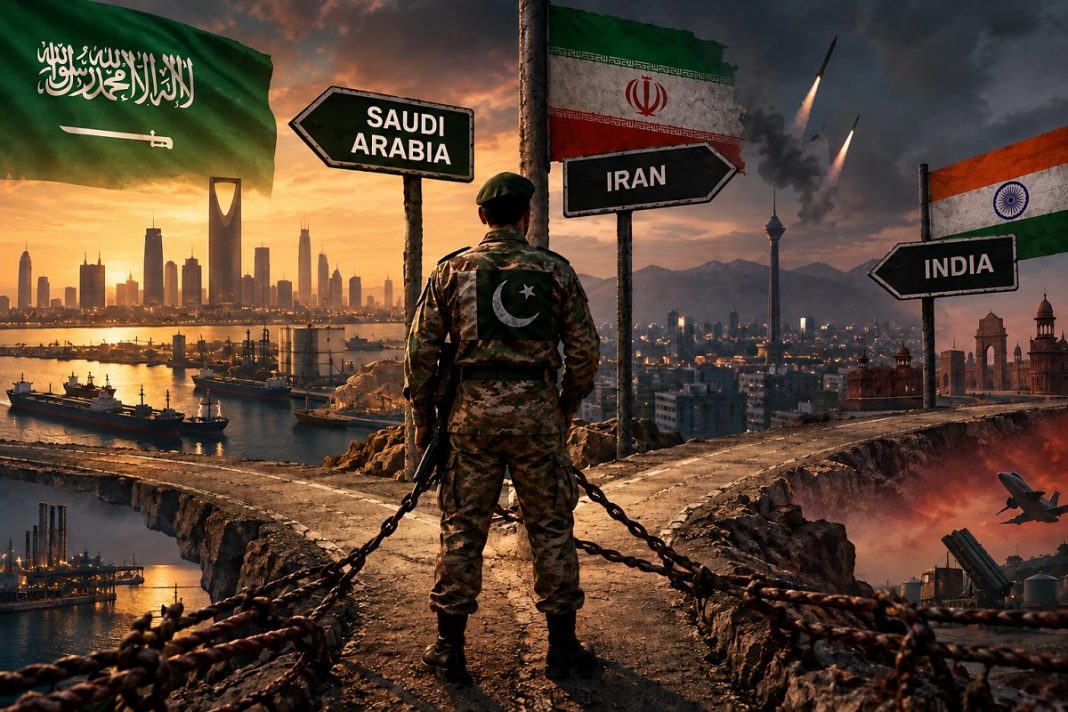
Pakistan has spent decades mastering a difficult balancing act in the Middle East: maintaining an exceptionally close relationship with Saudi Arabia while keeping channels open to neighboring Iran and ensuring that its overriding strategic rivalry with India remains manageable. New Gulf defense commitments are making that balancing act considerably harder.
The question is no longer whether Pakistan is becoming a more important security player in the Gulf. It is what happens when political promises of mutual defense are tested by an actual crisis—and Islamabad discovers that honoring one relationship may require putting another at risk.
For decades, this was largely manageable. Pakistan’s military relationships with Gulf states centered on training, coordination, personnel and bilateral defense cooperation. Such arrangements allowed Islamabad to deepen ties with Riyadh without necessarily defining what it would do in a regional war.
Mutual-defense commitments change that calculation. Promising to help defend another country is relatively uncomplicated in peacetime. The difficulty begins when the promise has to be honored.
Consider a large-scale attack on Saudi Arabia. The immediate question would be how far Islamabad was prepared to translate political commitments into military action. If Iran—or an Iran-aligned force—were responsible, the dilemma would become considerably more acute.
Iran is not a distant adversary for Pakistan. It is a neighbor with which Pakistan shares roughly 900 kilometers of border, including areas already affected by smuggling, militancy and recurring security tensions. An open confrontation with Tehran could therefore carry consequences inside Pakistan itself. Islamabad would effectively risk opening a strategic problem to its west while India remains its overriding security concern to the east.
Yet Pakistan cannot treat its commitments to Saudi Arabia lightly either. The relationship is deeper than a conventional defense partnership. Over decades, it has encompassed military, political, economic and financial support. Hesitation at a moment when the kingdom faced a serious threat could therefore raise uncomfortable questions about what Pakistan’s new defense commitments actually mean.
There is a precedent.
In 2015, when Saudi Arabia sought military support for its campaign in Yemen, Pakistan’s parliament voted against direct participation and favored neutrality. The decision demonstrated that even the close Saudi-Pakistani relationship had limits when military involvement threatened Pakistan’s domestic and regional balancing act.
Maintaining that distance may be much more difficult today as Islamabad assumes more explicit defense obligations.
Pakistan’s nuclear arsenal adds another layer of complexity. The presence of a nuclear-armed state in Gulf defense arrangements inevitably raises expectations, even without an explicit declaration of a nuclear umbrella. But Pakistan’s nuclear deterrent was developed primarily in the context of its rivalry with India, not to manage Middle Eastern conflicts or guarantee the security of states far from South Asia.
Islamabad therefore faces a delicate problem. The more it suggests that nuclear capabilities stand behind its new defense commitments, the more it raises expectations among partners—and anxieties among potential adversaries. Yet the more ambiguous it remains, the wider the potential gap between the political message and the military guarantee.
Nor do Pakistan’s calculations end with Saudi Arabia and Iran. India is watching its rival’s expanding Gulf role closely.
New Delhi has spent years developing increasingly important economic and strategic relationships with Saudi Arabia, the United Arab Emirates and other Gulf states. The region is critical to India’s energy supplies, trade and investment, and millions of Indian citizens live and work there. India is therefore unlikely to be indifferent to Pakistan’s evolution from a longstanding military partner of Gulf governments into a more consequential participant in regional defense arrangements.
This creates a paradox for Islamabad: the greater its influence in the Gulf, the greater the constraints that influence may impose on its freedom of maneuver elsewhere.
Turkey’s entry into the emerging defense arrangements partly reduces the burden Pakistan might otherwise carry alone. Ankara possesses a large military, a sophisticated defense industry and substantial operational experience. But trilateral cooperation also raises questions that political declarations alone cannot answer.
Who determines that an attack requires collective action? What form should that action take? Would it mean deploying forces, providing air defenses, sharing intelligence or offering logistical support? And what happens when the three partners agree that an attack has occurred but disagree over the adversary, the appropriate response or the risks of escalation?
Alliances rarely face their most difficult tests when they are signed. They face them when their members’ interests diverge in a moment of danger.
That is Pakistan’s emerging predicament. Islamabad has achieved a genuine strategic gain by moving from a traditional military partner to a sought-after participant in new regional arrangements. The shift gives Pakistan political influence and a role extending well beyond its traditional South Asian strategic theater.
But influence brings obligations.
A country that sells weapons or provides military training retains considerable freedom to decide the limits of its involvement. A country offering a security guarantee may eventually have to choose when the interests of its friends collide with its own.
Pakistan’s greatest challenge, therefore, may be preserving one of the advantages that has served its foreign policy for decades: maintaining close relationships with competing powers without being forced to choose among them. The clearer its defense commitments become, the narrower the ambiguity that once made such flexibility possible.
Pakistan has long managed to be Saudi Arabia’s close friend, Iran’s neighbor and India’s principal rival without having to test all three relationships at once. Its new defense commitments may make that balancing act much harder.
Security guarantees generate influence while war remains distant. When a crisis arrives, however, they demand a price. The question then will not be what Islamabad signed, but which of its relationships it is prepared to risk in order to honor its signature.
This article was originally published in Arabic on the Asswak Al-Arab website