Gabriel G. Tabarani
Publisher and Editor-in-Chief, Asswak Al Arab (Arab Markets)
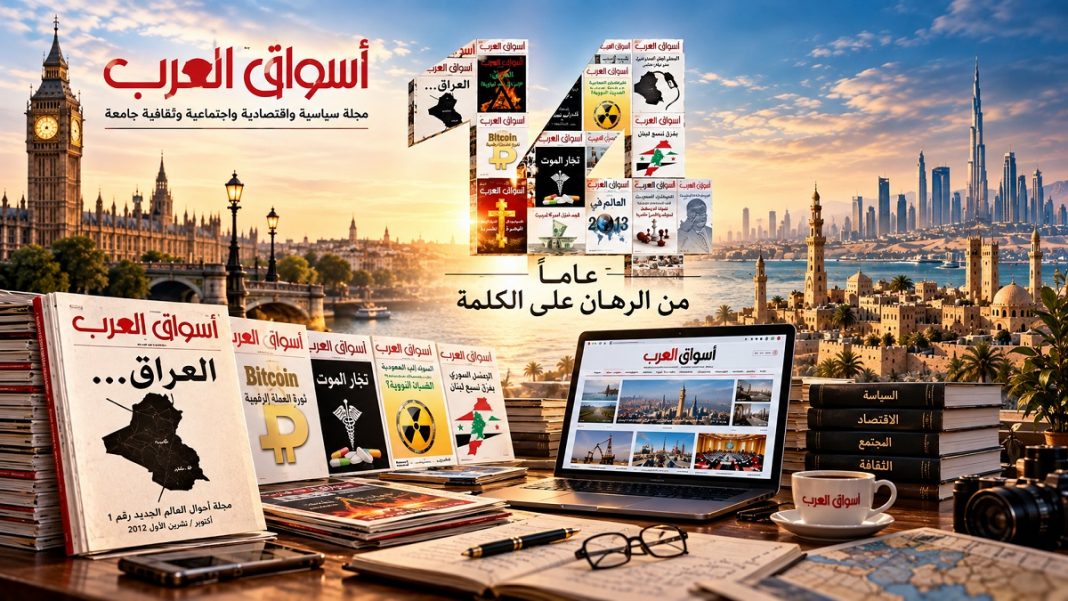
Fourteen years ago, around this time, the first issue of Asswak Al Arab (Arab Markets) reached its readers.
That was in October 2012. Fourteen years may not seem particularly long in the ordinary measure of time. But measured against the transformations our region has endured — and the extraordinary changes that have reshaped journalism itself — it feels almost like an era.
Much has changed since that first issue.
Governments and countries have changed. Wars have erupted, while others have subsided only to give way to conflicts of a different kind. Illusions have collapsed. Powers have risen and fallen. Alliances have shifted, and political and economic maps once thought relatively stable have been shaken.
Journalism, too, has changed profoundly.
Print has retreated as screens have taken over. The news cycle has accelerated to the point where a story can seem old only minutes after it breaks. Social media, followed by artificial intelligence, has moved to the very heart of the profession. Access to information has never been easier; verifying it, understanding it, and placing it in context has rarely been more difficult.
Through all of this, Asswak Al Arab has endured.
We do not say this merely to celebrate survival. Longevity, by itself, is no achievement, and continuity has little value if it becomes repetition. What is worth reflecting on, fourteen years later, is that the idea on which this publication was founded remains relevant — perhaps more urgently so today than it was then.
The Arab world needs journalism that looks at the region from within without becoming confined by it; journalism that understands economics through politics, and politics through history, geography, and interests; journalism that gives culture, ideas, and society their rightful place in understanding a present that cannot be reduced to a breaking-news alert or an official statement.
When we launched Asswak Al Arab in London in 2012, we never intended it to be an economic magazine in the narrow sense that its name might suggest.
We wanted it to be a broad Arab publication — political, economic, social, and cultural — looking outward from the region to the world, and back at the region from a global perspective. Its purpose was never simply to tell readers what had happened. It was to try, as seriously as possible, to answer the harder questions: Why did it happen? And where might it lead?
Those questions have accompanied us throughout these fourteen years.
They have not been easy years, either for our region or for journalism.
Since 2012, the Arab world has lived through one of the most turbulent periods in its modern history: the aftermath of the Arab uprisings, civil wars, the rise and fall of extremist organizations, Arab-Iranian rivalry, far-reaching transformations in the Gulf, Lebanon’s collapse, the Syrian tragedy, wars in Yemen and Sudan, the Palestinian question and the wars in Gaza, and the continuing reshaping of the balance of power across the Middle East.
Beyond the region, the international order itself has been changing. A world that for a time appeared relatively stable under near-unrivalled American leadership has given way to one marked by sharper competition and uncertainty: the rise of China, the return of Russia as an assertive power, and the growing importance of energy, technology, trade routes, and maritime corridors as instruments of influence and power.
Asswak Al Arab had to change as well.
A newspaper or magazine that fails to evolve with its readers and its times eventually becomes a witness to the past rather than an eye on the future.
Asswak Al Arab moved from the rhythm of a monthly print magazine into a digital space that does not wait for the next issue to appear. The website became our daily platform, and the range of writers, subjects, and perspectives expanded. Yet one principle remained unchanged: speed must never become a substitute for accuracy, sensation must never replace knowledge, and political conviction must never take the place of analysis.
That may be the central challenge facing journalism today.
The world no longer suffers from a shortage of information. It suffers from an excess of it.
A reader now carries in a smartphone more news, images, commentary, and data than even major newsrooms could gather a few decades ago. Yet amid this torrent, the reader needs more than ever someone to sift through it, connect the dots, place facts in context, distinguish information from propaganda, analysis from wishful thinking, and what truly matters from what has merely been designed to attract attention.
Journalism’s task, therefore, can no longer simply be to arrive first.
Perhaps its more important responsibility today is to remain calm when everyone else is shouting; to be precise when competing narratives proliferate; and to remain independent when polarization intensifies.
That is not an easy mission in the Arab world.
Arab journalism operates in an environment burdened by political, sectarian, and ideological divisions, economic pressures, and the persistent expectation that a journalist must be either an ally or an adversary.
From the beginning, however, we have believed that journalism that chooses its camp before it chooses the truth will sooner or later lose the very reason for its existence.
Independence does not mean having no opinions.
We have opinions. We take positions. Our editorials make them clear. We may be right in one judgment and wrong in another. But independence means that readers retain the right to know the facts as they are; to read an opinion that does not disguise itself as news; and to find in our pages more than one voice and more than one perspective.
Fourteen years on, I do not claim that Asswak Al Arab has achieved everything we once hoped it would.
Journalism is a project that is never complete. Every article is another test. Over the years, we have learned as much as we have written — from our mistakes as well as our successes, from our readers as much as from our writers.
But there is one thing I know: we have never lost our faith in the power of the word.
The region we wrote about in October 2012 is not the same region we write about in October 2026. The world is not the same. Nor is the reader.
Yet the need for serious journalism has not diminished.
Quite the opposite.
The more tools of communication multiply, the greater the need for someone to give communication meaning. The more information there is, the more valuable knowledge becomes. And the louder the noise of polarization grows, the rarer — and more precious — an independent voice becomes.
On this anniversary, there must also be a word of gratitude.
To those who helped launch this project and carried it through its early years. To the editors, writers, correspondents, and experts who have given Asswak Al Arab their knowledge, time, and experience. To those who passed through these pages and left their mark, and to those who continue to write with us today.
And to every reader who picked up an issue of the magazine, visited the website, sent us a comment, disagreed with us, corrected a fact, or simply gave an article a few minutes of their time and their trust.
They are all part of these fourteen years.
Our greatest thanks, however, must go to the reader.
Journalism, in the end, does not survive on what it says about itself. It survives on the trust readers place in it. And that trust is not a certificate granted once and kept forever. It is a responsibility that must be earned again, every single day.
It was during this week in 2012 that we began the journey of Asswak Al Arab. We could not have known where it would take us, how dramatically the profession would change, or how many political and economic earthquakes would shake the region and the world along the way.
Today, fourteen years later, we do not want to spend too much time looking back.
What matters is what the past has taught us.
The future is already confronting journalism with even larger questions.
What will artificial intelligence do to information and to the profession that gathers and interprets it? How do we protect truth in an age when almost anyone can manufacture a “truth” of their own? How can journalism regain the confidence of readers exhausted by propaganda and polarization? And how can Arab media learn to anticipate and understand the great transformations ahead rather than merely record them after they occur?
These are among the questions of the next era.
They are also the questions that Asswak Al Arab must continue to ask.
Fourteen years have passed since our first issue. The tools have changed. The world has changed. And we have changed with it.
But there is one thing we hope will never change: that behind every news story there remains a question, behind every analysis a search for understanding, and behind every position a sense of responsibility; that the reader remains our purpose, and that truth — however difficult or uncomfortable — remains our compass.
Because, in the end, the value of journalism is not measured by the number of years it survives.
It is measured by whether, after all those years, people still have a reason to read it.
For Asswak Al Arab, that is where year fifteen begins.
This article was originally published in Arabic on the Asswak Al-Arab website