Gabriel G. Tabarani*
Morocco has demonstrated that it can attract international manufacturers, develop world-class infrastructure and establish itself as a competitive industrial base on Europe’s southern doorstep. Its next challenge is more demanding: ensuring that these achievements generate greater domestic value, more productive employment and prosperity that extends beyond the country’s principal economic centres.
That question has become particularly relevant as the global economy undergoes a period of profound adjustment. Manufacturers are reconsidering supply chains, governments are competing for strategic technologies, and access to energy and critical resources increasingly shapes investment decisions. Countries capable of combining industrial infrastructure, political stability and proximity to major markets stand to benefit from these changes. Morocco is well positioned to seize some of those opportunities, but doing so will require a shift in emphasis — from attracting investment to extracting more lasting economic benefits from it.
King Mohammed VI’s address to Morocco’s newly elected parliament on Friday offered an important political framework for this next stage. By linking the kingdom’s ambition to become a more influential economic power with social and regional equity, institutional effectiveness and economic security, the monarch placed several of Morocco’s most consequential development questions at the centre of the national agenda. The significance of the speech lies less in any individual policy announcement than in the relationship it draws between economic ambition and the capacity to deliver meaningful results.
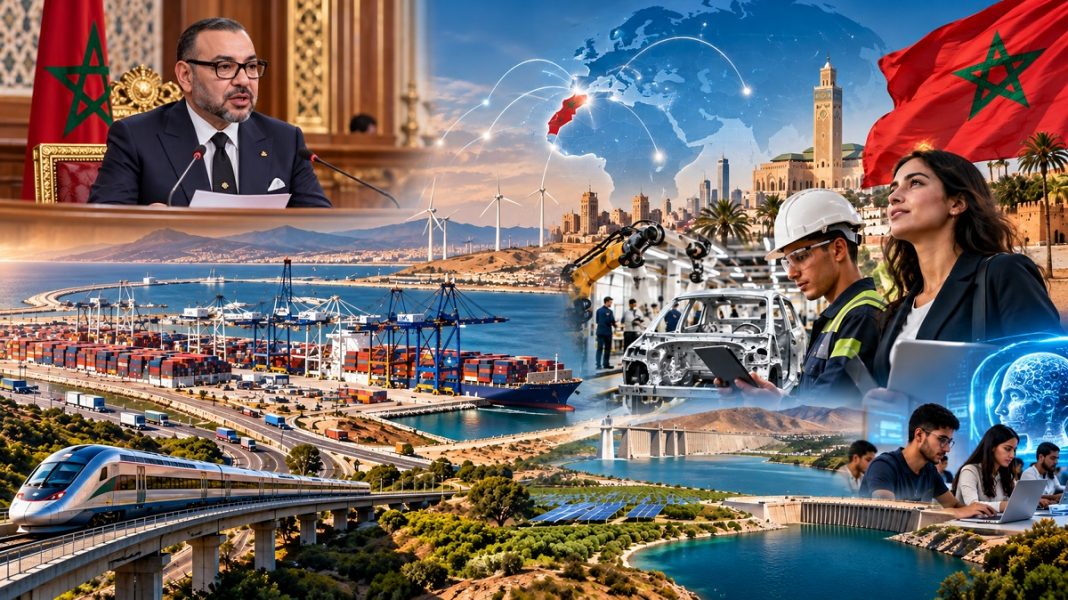
Over the past two decades, Morocco has steadily transformed its economic position. Investment in transport infrastructure, industrial zones and logistics has helped establish the country as a manufacturing platform connecting Europe and Africa. The Tanger Med port complex has become a defining symbol of this transformation. Its integration into international shipping networks has reinforced Morocco’s attractiveness to manufacturers seeking efficient access to European and other markets, while the development of automotive and aerospace industries has demonstrated the kingdom’s ability to host increasingly sophisticated production activities.
These achievements matter because industrial competitiveness tends to develop cumulatively. Infrastructure attracts manufacturers; manufacturers encourage the emergence of suppliers; and a deeper industrial ecosystem can, in turn, attract more technologically advanced investment. Yet there is an important distinction between participating in global production networks and capturing a substantial share of the value they generate. For Morocco, the next stage will depend increasingly on the development of domestic suppliers, engineering capabilities, research and innovation. The objective should be not merely to manufacture more goods, but to increase the Moroccan contribution to their design, technology and production.
The automotive industry illustrates the opportunity. As manufacturers move towards electric vehicles and battery technologies, Morocco has an established industrial base on which to build. Its longer-term competitiveness, however, will depend on whether local businesses and workers can move into higher-value activities associated with this transition. This is where the king’s emphasis on the private sector assumes particular importance. Moroccan companies must become more than beneficiaries of large industrial projects. They need to participate more deeply in supply chains, develop specialised capabilities and compete in markets beyond their traditional reach.
For smaller and medium-sized enterprises, access to financing, technology and skilled labour will be essential. A stronger domestic business ecosystem would make foreign investment more valuable to the Moroccan economy while reducing dependence on a relatively narrow range of industrial activities.
Industrial growth is an important achievement, but its broader economic significance depends on the opportunities it creates for society. Morocco’s modern manufacturing sectors have expanded its productive capabilities and export potential. Yet the relationship between industrial investment and employment is becoming more complex. Advanced manufacturing increasingly relies on automation, specialised skills and technological processes that do not necessarily generate jobs in proportion to investment. The challenge is therefore not simply to create more industrial employment, but to develop a workforce capable of participating in a more technologically demanding economy.
Education and vocational training are central to this effort, as is the ability to connect qualifications with the changing requirements of employers. Mohammed VI’s emphasis on young people, training and equal opportunity reflects the importance of this connection. Human capital is no longer merely a social-policy consideration; it is a decisive component of economic competitiveness. A country may offer attractive infrastructure and investment conditions, but its capacity to retain sophisticated industries ultimately depends on the availability of skilled workers, engineers, technicians and entrepreneurs. For Morocco, investing in people must become as central to the development strategy as investing in ports, industrial zones and transport networks.
There is also a geographical dimension to the challenge. Industrial activity and investment have tended to concentrate around major urban centres and established economic corridors. Other regions possess different resources and opportunities but often face greater difficulties attracting capital and developing productive employment. A more balanced development model does not require every region to follow the same industrial path. It requires institutions capable of identifying local advantages and mobilising the resources needed to develop them.
This gives particular relevance to the king’s call for faster implementation of advanced regionalisation and administrative decentralisation. Transferring responsibilities and resources to regional authorities could improve investment decisions, strengthen public services and make economic policy more responsive to local conditions. But decentralisation produces results only when responsibilities are clear and institutions possess the means to exercise them. Effective implementation, rather than administrative restructuring alone, will determine whether regional reform helps narrow economic disparities.
Morocco’s next development phase must also contend with constraints that are becoming increasingly important across the global economy. Water scarcity is perhaps the most immediate. Its implications extend well beyond agriculture, affecting industrial planning, infrastructure investment and the long-term allocation of resources. Climate pressures make efficient water management a strategic economic priority. They also raise difficult questions about how countries balance agricultural production, industrial development and the needs of growing urban populations.
Energy presents another challenge, but also a substantial opportunity. Morocco’s investment in renewable energy could strengthen its industrial competitiveness as international manufacturers place greater emphasis on energy security, costs and environmental performance. The opportunity is especially relevant as European industries adjust to changing energy and regulatory requirements.
The king’s call for renewed strategies in water, energy and food security reflects a broader shift in economic thinking. Recent international disruptions have demonstrated that openness to global markets must be accompanied by sufficient resilience to withstand external shocks. For Morocco, economic security should not mean retreating from international trade. It should mean developing the capacity to remain competitive and reliable even when global conditions become less predictable.
Digital technology and artificial intelligence form another part of this equation. Their greatest contribution may come not from the creation of entirely new industries, but from improving productivity across manufacturing, logistics, agriculture and public administration. Yet technology adoption alone is insufficient. The lasting gains will come from building domestic expertise and encouraging businesses to innovate rather than merely import solutions.
Geography remains one of Morocco’s strongest strategic assets. Its proximity to Europe, access to African markets and established relationships with Gulf investors give it opportunities to participate in the reorganisation of international trade and investment. As companies seek to diversify supply chains and bring some production closer to major consumer markets, Morocco can offer a combination of industrial infrastructure, logistical connectivity and access to several economic regions.
But geography is an advantage only when supported by productive capabilities and dependable partnerships. The kingdom’s growing industrial base could enable it to play a more significant role in connecting European manufacturing networks with African economic opportunities. Investment partnerships with Gulf countries could also contribute capital and expertise to infrastructure, energy and industrial development. The wider challenge is to translate these relationships into durable economic integration rather than a succession of individual investment projects.
In this context, Mohammed VI’s call for a renewed approach to co-operation with European partners, particularly Spain over migration, has implications beyond the immediate issue. Migration is a complex subject involving security, economic opportunity, legal obligations and human considerations. A more sustainable partnership requires an approach that recognises these overlapping interests. The broader principle is that international relationships become more resilient when they are supported by shared economic opportunities, mutual respect and long-term development objectives.
For Morocco, strengthening its international position will increasingly depend on combining diplomatic flexibility with a competitive and diversified domestic economy.
Morocco has already made considerable progress in establishing the foundations of a modern industrial economy. Its infrastructure, manufacturing capabilities and international connections provide a platform for further development at a time when the geography of global production is changing. The next phase, however, will be judged by different measures.
Higher export volumes will remain important, but so will the share of value created by Moroccan businesses. New industrial investment will continue to matter, but its contribution to employment, skills and technological development will become increasingly significant. Economic growth will be more durable if its benefits reach regions and communities that have participated less fully in the country’s industrial expansion.
These objectives are closely connected. Stronger education supports more sophisticated manufacturing. More capable domestic businesses increase the economic benefits of foreign investment. Effective regional institutions can broaden access to opportunity. Greater security in water and energy strengthens the resilience of the entire economy.
The king’s parliamentary address is significant because it places these relationships within a common development framework. The challenge now is to translate that framework into policies whose results can be measured in productivity, employment, institutional performance and living standards.
Morocco’s economic transformation has reached a stage at which building additional capacity, while still necessary, is no longer sufficient. The country has shown that it can become an attractive destination for global industry. Its next achievement must be to ensure that industrial success produces a deeper, more innovative and more inclusive domestic economy.
That is how Morocco can turn its growing international economic presence into a lasting source of national prosperity.
This article was originally published in Arabic on the Asswak Al-Arab website