Gabriel G. Tabarani
The next global economic crisis may not begin with the collapse of China’s economy. It may begin with Beijing’s determination to prevent one. By producing and exporting more to compensate for weak domestic demand, China can sustain growth and employment at home. But it also shifts the burden of its economic imbalances onto other countries. The policies keeping Chinese factories running today could eventually destabilize the global economy on which those factories depend.
This is not a prediction of imminent collapse. It is a warning about an economic model whose continued success increasingly requires the rest of the world to absorb its excess production.
China built its extraordinary rise on investment, manufacturing and exports. But that model is under strain. A prolonged property downturn has weakened household confidence, local governments are burdened by debt, and consumers remain reluctant to spend. Rather than decisively shifting resources toward household incomes and consumption, Beijing continues to prioritize factories, technology and strategic industries—as though the imbalances accumulated by an investment-driven economy could be corrected through still more investment.
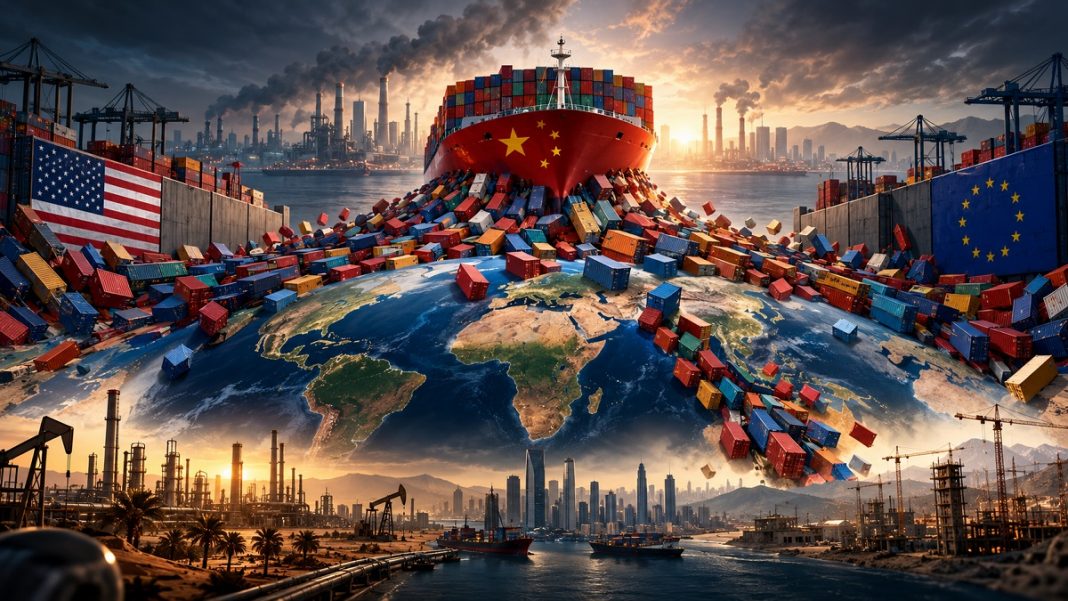
China recorded a trade surplus approaching $1.2 trillion in 2025. The figure reflects remarkable industrial strength, but also a fundamental imbalance: China produces far more than its domestic market can absorb. Exports have become increasingly important not simply to expanding the economy, but to sustaining its stability.
Chinese industrial success is not inherently troubling. Consumers worldwide have benefited from affordable goods, while Chinese manufacturers have accelerated the adoption of electric vehicles, batteries and solar technology. The problem arises when production keeps expanding despite weakening profitability, sustained by subsidies and credit rather than sufficient demand. Low prices then reflect not only efficiency, but also the pressure to dispose of excess output abroad.
The international response is predictable. As Chinese exports intensify competition, manufacturers elsewhere demand protection. Washington raises trade barriers. Europe seeks to defend vulnerable industries. Developing countries, hoping to establish their own manufacturing bases, face similar pressures.
Each defensive measure makes China more dependent on finding alternative markets. Beijing’s efforts to preserve jobs at home threaten jobs elsewhere, provoking policies that make China’s own predicament harder to resolve.
But the deeper danger lies in a paradox: Every major economy could succeed in its immediate objectives and still leave the world worse off.
China might preserve industrial employment. The United States might protect selected manufacturers through tariffs. Europe might reduce its dependence on Chinese imports. Yet the combined result could be weaker trade, less investment, higher costs and a more fragmented global economy.
National economic victories, pursued without regard for their collective consequences, can become a recipe for global failure.
Developing countries are particularly exposed. They benefit from inexpensive Chinese products, but they also need industries capable of creating jobs and raising incomes. When an industrial powerhouse competes across basic and advanced manufacturing alike, poorer economies may struggle to establish productive sectors of their own. The losses include not only factories that close, but factories that never open.
The greatest danger, however, may emerge when China can no longer sustain its export-driven response to domestic weakness.
If trade barriers and slowing global demand sharply reduce Chinese exports, financially strained manufacturers could fail. Banks would face mounting losses, indebted local governments would come under further pressure, and investment would weaken. Industrial overcapacity could then become a broader credit crisis, with consequences extending far beyond China.
China is not merely the world’s factory. It is also one of its largest customers for energy, metals and industrial commodities. A severe contraction in Chinese investment would hurt exporters across the Middle East, Africa and Latin America. Gulf economies could face repercussions extending beyond oil prices to petrochemicals, logistics and investment flows.
A global crisis is hardly inevitable. China retains substantial financial resources and considerable capacity for state intervention. Industrial overcapacity does not automatically produce financial collapse. The risk is that falling exports, corporate defaults, banking losses and weakening commodity demand could reinforce one another, turning a manageable adjustment into a much larger shock.
The world is poorly positioned to confront such a crisis. Government debt is elevated, borrowing remains costly, and trust among major powers has deteriorated. International coordination helped contain the financial collapse of 2008, even though a future China-centered crisis would follow a different path. Today, rivalry between Washington and Beijing could obstruct a comparable collective response.
The underlying problem is not simply China’s reluctance to confront the limits of its economic model. It is that major powers increasingly behave as though domestic stability can be secured by shifting economic costs abroad.
Beijing relies on exports to offset weak consumption. Washington turns to protectionism to revive manufacturing. Europe seeks greater industrial autonomy. Each strategy has a defensible national rationale. Together, they risk undermining the international economy on which their prosperity depends.
The answer is neither to demand that China abandon its industrial strengths nor to expect other countries to accept unlimited competition from subsidized production. Beijing needs to strengthen household incomes and consumption while reducing support for commercially unviable capacity. Western governments must recognize that tariffs may protect particular industries without resolving the imbalances driving the conflict.
China has demonstrated that it can manufacture what the world wants. Its harder challenge is to build an economy in which its own citizens can afford to buy more of what it produces.
The next global crisis could arise not because governments failed to defend their national interests, but because each succeeded in doing so at everyone else’s expense.
This article was originally published in Arabic on the Asswak Al-Arab website